

When is a Wingmast a good choice ... and when is it not.
[ As the German Multihull Association will be exhibiting a Mk.l wingmast (on a W17) at the upcoming Dusseldorf Boat Show Jan 18-26th, 2025, and we are also finally making available the long awaited Mk.ll WingMast Manual for masts 11-16m within a few weeks, I thought it was the right time to spell this out ].
It is well known by aerodynamists that the leading edge of a wing or sail is the most critical part. Inefficiencies here will severely reduce lift and add drag.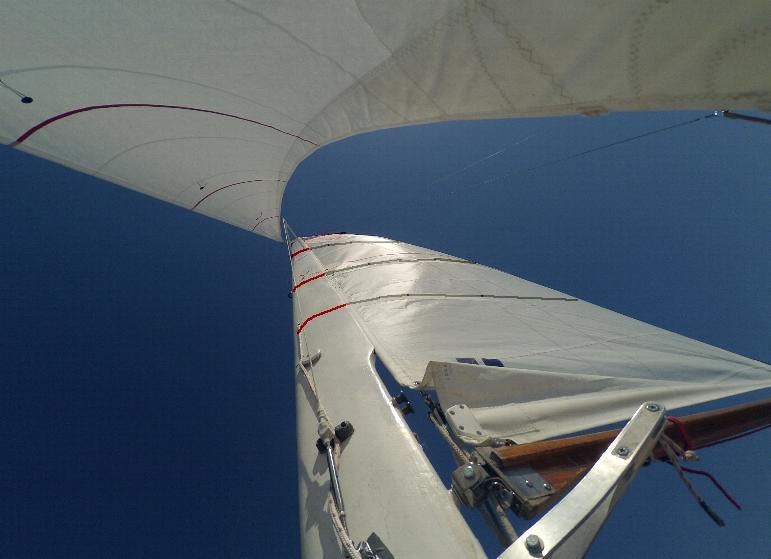
By making this forward edge rigid but rotatable, these inefficiencies can mostly be avoided. The difference with a non-rotating mast that is typically wider with more drag than a wingmast, is such, that all fast record-setting boats today set wingmasts. including IMOCA 60’s, Ultimate trimarans and America Cup boats using foils. More boats would likely set them when appropriate, except that most class boats still prohibit their use as they add ‘performance at a price’, meaning that those with less financial means would be slower .. which understandably, is not a desirable formula. There are also other reasons a wingmast should or cannot be installed on some boats that will be addressed below.
But if a class permits it and where such a mast is appropriate, a way of building your own wingmast with considerable savings, is an attractive way to upgrade performance, particularly upwind, though there can be other benefits that are not often acknowledged. These include using the mast highly rotated as a vertical fence when sailing downwind, as well as negatively rotating it to stall and de-power the rig when caught with too much sail up. Cruising multis have also used wingmasts to keep moving in gale-force winds, when setting any sail was too much, so managing to sail with enough forward motion upwind to keep an autopilot functioning and with a speed downwind approaching 50% of the boats maximum while enjoying zero risk of broaching or gybing. When I addressed this question a while back in an article "Wing-Masts on Multihulls", I added a paragraph in Italics that also covers another cool way that a pair of wingmasts helped a 52ft trimaran sail both up & down wind in a gale. Check it out HERE:
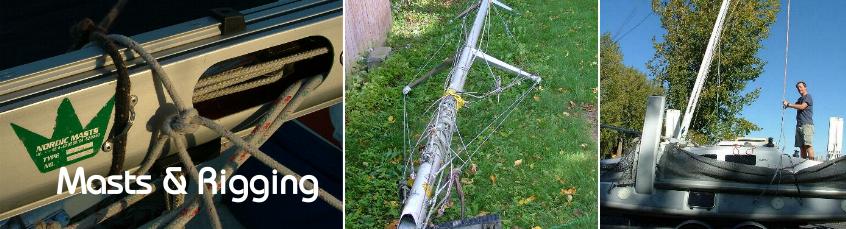
Typically, a wingmast tends to be stronger than a conventional oval mast that flexes between its supporting stays, as the fore and aft section of a wingmast gives a VERY high Moment of Inertia, while the lower transverse Mt of I can be readily compensated by adding one or two diamond spreaders perpendicular to the mast centerline, making such masts both highly effective and stable. See Mk.1 mast at left.  This arrangement allows the mast to be fully supported regardless of its rotation angle, something we cannot say of the old traditional rig unless it is cluttered with an excessive amount of extra rigging .. rigging that adds cost, weight aloft and much wind drag.
So the pluses of a wingmast are indeed quite noteworthy.
But are there negatives ? Nothing comes totally free. Wingmasts have more material so are inevitably heavier and need to be rotated to the right angle for the situation …. which could be not only for sail efficiency but for reduced heeling when at a dock. (However, there is typically a saving in rigging weight with only 3 stays, two of which are often of Dyneema). They also bring with them the need to modify the mainsail, as typically sail camber will need to be about 40% of what is used with a conventional mast. This is not a factor if the sail was to be replaced anyway.
But finally, they cost more, except that there is now a way to make your own at around 10-15% of the pro cost, which is why the Waters Wingmast is becoming a popular option.
But when is a Wingmast NOT a good idea ?
In summary, when its added thrust and weight negatively affect stability, or if the support base is too narrow. Let’s look closer at these factors
A wingmast adds thrust on the leeward forward side of the mast, so ‘pulling’ an upright boat forward. However, if a wingmast is mounted on a boat that heels over say 15 deg, this thrust starts in impart a downward component that now heels the boat even more. Further, for boats heeling more than about 20 degrees, the weight of the mast, now inclined to leeward, adds an additional heeling moment and this is particularly concerning for a monohull when the mast component will now fall to leeward outside of the stabilizing hull waterplane. Further, as the wingmast needs to be supported from a point abovo the diamonds, the shrouds need to be spread quite wide to allow mast rotation. This is not an issue on a multihull, but a monohull would either need to be very wide, or have spreader booms out from the boat sides, as we see on boats like the IMOCA-60's. This is just not practical for most monohulls that race around-the-buoys or need to tie up at docks..
For these reasons, a wingmast can only be recommended for a sailboat that is either a multihull, or a monohull both stabilized by foils and accept to be rigged with deck spreaders to widen the shroud base.
Mike Waters 2025.
"New articles, comments and references will be added periodically as new questions are answered and other info comes in relative to this subject, so you're invited to revisit and participate." —webmaster
"See the Copyright Information & Legal Disclaimer page for copyright info and use of ANY part of this text or article"